Space Tech
Water treatment for extraterrestrial use
By reducing the need for resupply missions, we save on costs, prevent pollution, and most importantly, reduce risk to human life.
Content
The unique proposition of Hydromars
Hydromars offers complete reuse of water in space regardless of feed type, size or charge. This means recovery of every single water molecule while at the same time as providing pure water for consumption and lab use.
Our equipment differs from presently available water treatment methods - it does not function as a filter; it is not an absorber, and it is not an ion exchanger.
We use a new unit operation for removal of contaminants from water and enable development of a compact on-demand point-of-use system. With us, access to space becomes sustainable.
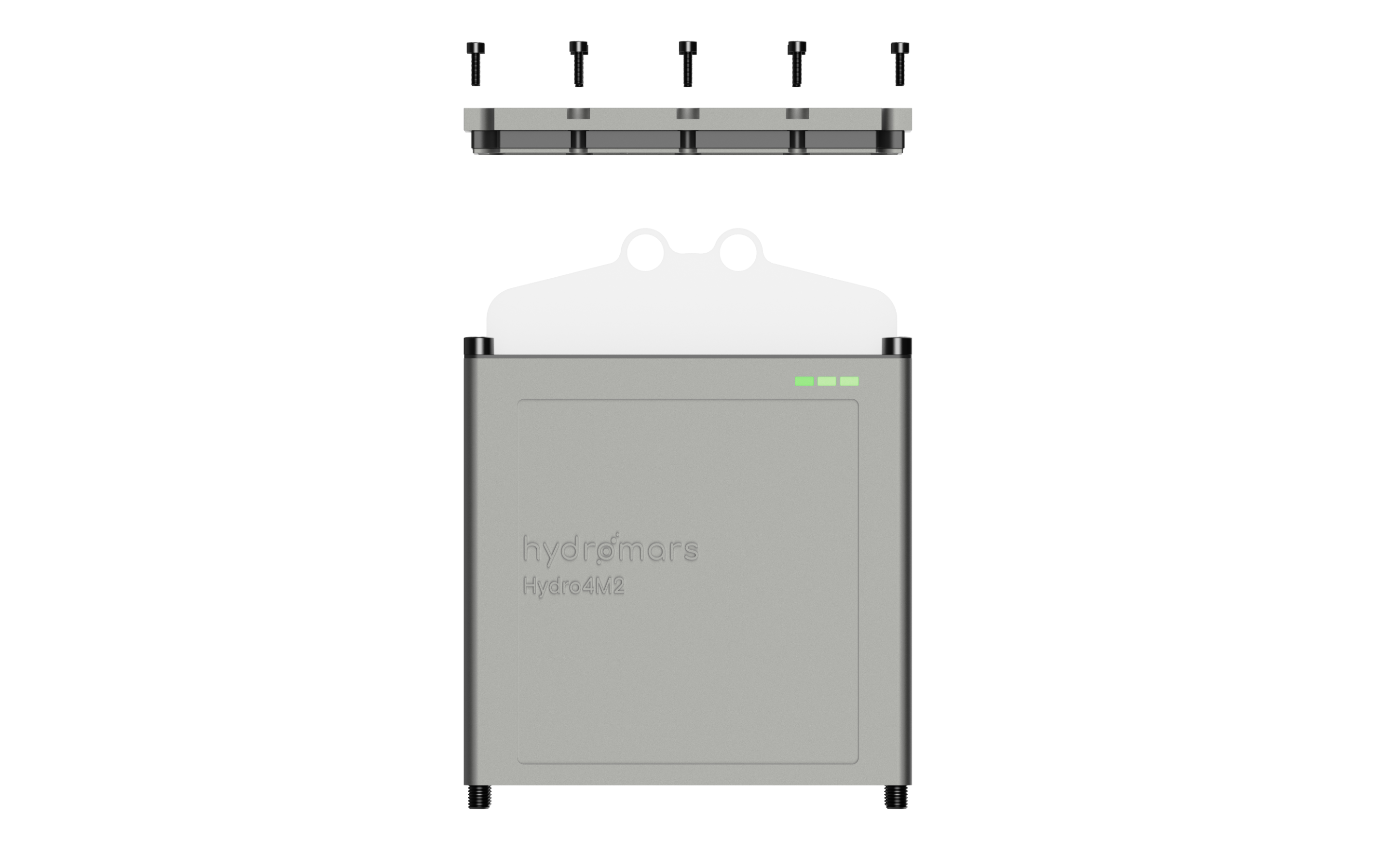
Hydro4M2 - validation in space
Hydromars was funded by the European Space Agency for a fully paid payload space onboard Nyx Orbital Space Vehicle as part of the “Mission Possible” orbital flight and reentry mission.
The launch is scheduled for Q2 2025 from Falcon 9.

HydroAMBS1 to test space wastewater mixtures
HydroAMBS1 is the first thermal pervaporation demonstrator that aims to purify all spacecraft wastewater and provide pure water for consumption and nutrient-rich retentate.
Known water purification solutions fail to solve the challenge of the complete and closed-circuit recovery of water from all waste streams with low energy usage and process complexity. This is what Hydromars is developing with the HydroAMBS1 experimental development project, where HydroAMBS1 stands for “Hydromars Automated Modular Breadboard System”.
Gulabo - our first generation proprietary prototype
Gulabo was developed in 2022 with financial and technical support from ESA and ESA BIC Sweden. It supports flat-sheet and hollow-fiber membrane module concepts and was tested on simplified ersatz urine solution with the resulting permeate characteristics matching the initial hypotheses.
This project resulted in a separate patent. The novelty behind the patent is a simple, cost-effective, and compact water purification method with no additional chemical additives needed for the purifying process and with consideration of microgravity conditions.

Hydromars solution for VESTA Habitat project
Hydromars is a consortium member and a task contributor for closed-loop water systems development within the German Aerospace Center (DLR) led VESTA Habitat project.
VESTA aims to develop a terrestrial analogue to a future extraterrestrial habitat on the moon and is the next step after the highly successful EDEN-ISS project at Neumayer Station in Antarctica.
As the task contributor, Hydromars is in charge of implementing a complete solution (initially, within the conceptual design stage of the 3-year project) to purify all wastewater streams while providing highly pure water for consumption along with a nutrient-rich retentate for growing plants.